
Define the process role before choosing the equipment
A bulk vibratory feeder is considered here as a way to present bulk material to a receiving process; a screw conveyor is considered as a transfer arrangement along a defined route. Depending on the actual design and controls, a process may need one, the other or both. The decision is not resolved by calling both machines “feeders.”
This comparison does not concern bowl feeders that orient discrete parts. It also does not establish a dosing accuracy, a universal flow range or an available configuration simply from a product name.
Draw the process boundary that needs control
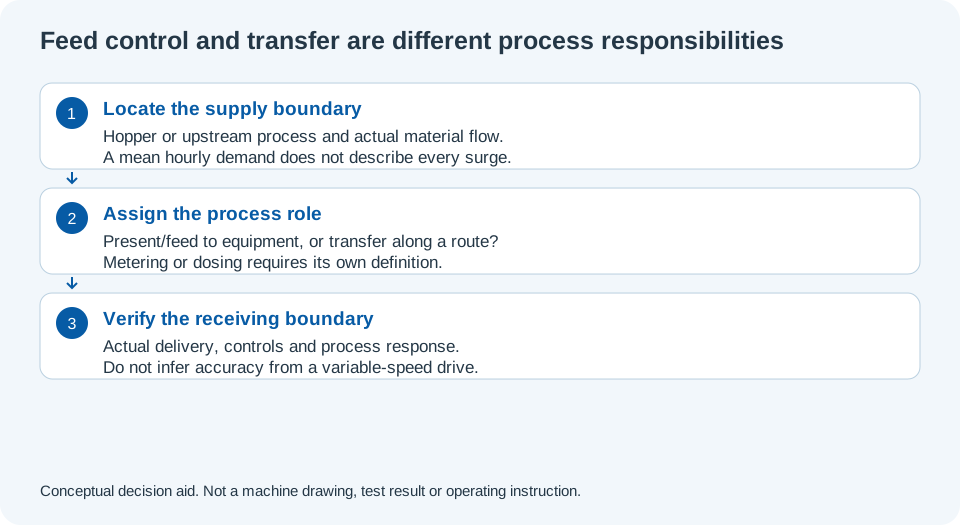
Identify the supplying hopper or process, the receiving equipment and the location where flow needs to be controlled or measured. A screen may need a stable presentation of material, while a downstream transfer may mainly need to connect two elevations or points. Those are different engineering questions.
The diagram is a process-role example, not a recommended circuit for every material. It does not specify a discharge control, interlock or hazardous-material handling system.
Compare functions without assuming performance
Ask what each proposed item is expected to do and which controls and interfaces are actually included. “Variable speed” and “adjustable feed” describe possible control inputs, not proof that a specified delivered-mass tolerance will be achieved.
| Process question | Bulk vibratory-feeder review | Screw-conveyor review |
|---|---|---|
| What is its main assigned duty? | Presentation or feeding to the receiving process | Transfer along the proposed enclosed route |
| What does it receive? | Hopper/process boundary and material flow condition | Controlled or changing inlet supply |
| What must be controlled? | Actual delivery to the receiving equipment | Transfer duty and any separately specified feed/dose role |
| What must be verified? | Flow behaviour, interfaces and required control response | Material, route, loading, discharge and access |
Define feeding, metering and dosing separately
If the requirement is a stable feed, state the operating range and the receiving process’s tolerance for surges. If it is a measured dose or mass-flow control, state the measurement boundary, interval and acceptance rule. Identify the weighing or other measurement system rather than inferring it from a drive.
A process may show an average rate that hides short interruptions or surges. Decide whether those variations matter to the downstream screen, mixer or packaging step, and record them in the test rather than presenting the average as a complete control result.
Characterise the material at both interfaces
Describe flow, cohesion, moisture condition, particle-size range, bulk density, fragility, abrasion, temperature and relevant safety information. Material can change through a route, so identify whether a sample represents the inlet, outlet or a different process stage.
For a screw, the route and supply boundary are part of the specification. For a vibratory feeder, the feed arrangement and receiving interface are part of the question. Neither should be selected solely by looking at a nominal motor or a general product photograph.
Check what happens outside steady operation
Describe start-up, shutdown, loss of supply, a downstream stop and an abnormal material batch. Ask which controls or interlocks are included, which belong to the wider plant and what the authorised response is. This article does not prescribe settings or bypasses.
For cleaning, containment and hazardous-material requirements, obtain the actual construction and permitted procedure. An enclosed-looking conveyor or a stainless trough is not, by appearance alone, a validated hygienic or hazardous-area solution.
Plan a test around the assigned process role
Measure at the boundary that matters. For a feed-control question, record delivered mass over defined intervals and relevant interruptions. For transfer, record actual material, route, supply and discharge conditions alongside useful output and product condition.
Keep configuration and operating differences visible. Do not claim a dosing advantage from unlike tests or use a successful transfer as proof of screening performance. The result should answer the duty assigned to that component.
Catalogue basis and next step
This article uses archived Zhenwei electromagnetic-feeder and screw-conveyor descriptions to identify the two product contexts. The role comparison is original explanatory content; it is not a measured control-accuracy study.
Send a process sketch showing where material arrives, where it must go and where delivery must be controlled. The product pages can then support a configuration discussion without confusing bulk handling with parts orientation or unverified precision dosing.