Conveying SERIES
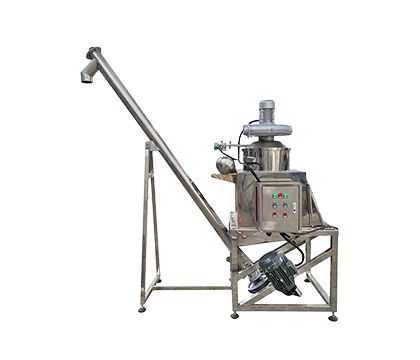
Screw Conveyor
A screw-conveyor arrangement specified around your material, length, inclination and inlet/outlet interfaces.
Equipment selection starts with your material, target separation and process conditions.
01
How the screw conveying process works
A rotating screw moves material along the conveyor housing. Material characteristics, layout and the required transfer duty influence the screw, drive, supports and interfaces.
02
Define the transfer or feeding duty
Discuss the sample and operating conditions before finalizing the configuration.
- Powder and granule transfer
- Feed and discharge integration
- Material and layout specification
03
Define the transfer path
Length, inclination and elevation change are essential inputs for a screw-conveyor enquiry. Feed density and behaviour also affect the proposed arrangement. The same nominal screw diameter does not imply the same transfer rate for different powders or inclinations.
- Show inlet and discharge locations in a dimensioned sketch.
- Describe whether the inlet is flood-fed or receives controlled feed.
- State temperature, moisture, bulk density and abrasive characteristics where known.
04
Distinguish conveying from metering
A conveyor moves material between points. Accurate dosing requires a defined control and measurement system; it should not be inferred from rotation speed alone. A proposal should also explain access for cleaning, inspection and removal of retained powder.
- Identify whether the duty is transfer, batching or continuous controlled feeding.
- Confirm the supplied screw, housing, seals and drive against the actual quotation.
- Do not assume shaftless or flexible versions are available without a specific supply confirmation.
05
Define an exact or small-diameter size request
For a request such as a 2-inch screw conveyor, identify whether the dimension refers to the screw, housing or a nominal connection. Provide actual dimensions and units rather than treating a nominal pipe designation as a measured shaft diameter. A size outside the displayed catalogue needs explicit configuration and supply confirmation.
06
Match a screw-conveyor request to the actual supply scope
Inclined, hopper-fed, stainless-contact, small-diameter, portable or silo-related requests need a defined drawing and application. The listed LS catalogue is not evidence of every flexible, shaftless or micro-dosing design. Grain, pellets, cement and powders impose different feed, wear and cleaning conditions; specify the actual material rather than assuming all screw conveyors are interchangeable.
CONFIGURATION REVIEW
Specify the machine for the task.
| Selection item | Information to confirm |
|---|---|
| Process role | Define material transfer or feed presentation; precision metering is a separate requirement. |
| Material and feed conditions | Supply bulk density, flow behaviour, moisture and temperature where relevant. |
| Interfaces and controls | Agree the route/tray, inlet/outlet, elevations, controller, interlocks and electrical supply. |
| Model and operating data | Use the catalogue table as a starting point; application output and final arrangement are confirmed for the proposed equipment. |
Final technical values, dimensions and performance conditions are confirmed against the proposed equipment and application.
TECHNICAL DATA
Models & specifications
| Model | Listed maximum conveying height (m) | Pipe diameter (mm) | Motor power (kW) |
|---|---|---|---|
| LS-100 | 1–3.5 | 110 | 1.1 |
| LS-133 | 1–3.5 | 133 | 2.2 |
| LS-141 | 1–3.5 | 141 | 2.2 |
| LS-168 | 1–4.0 | 168 | 3 |
| LS-219 | 1–4.0 | 219 | 3 |
| LS-400 | 1–4.0 | 400 | 5.5 |
The legacy catalogue notes that horizontal conveying distance may be longer. Height is not conveyor length; the actual incline and layout must be specified.
Screw Conveyor
DISCUSS
YOUR TASK
Let's review the application.
Provide the material, separation target and process requirements so that the equipment configuration can be discussed.