
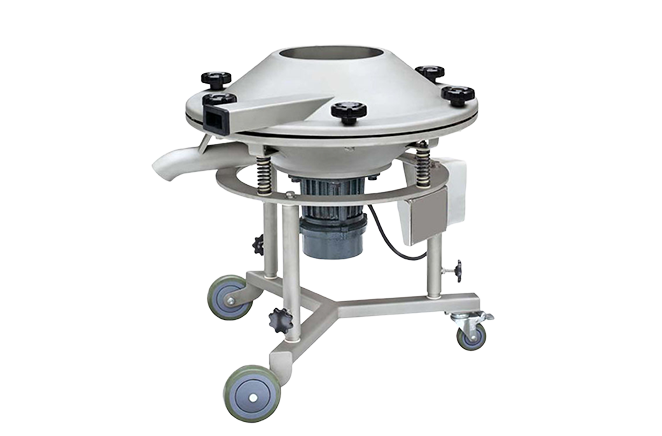
Screening SERIES
High-frequency Vibrating Screen
Evaluate the material, desired separation and screen configuration for a high-frequency screening application.
Equipment selection starts with your material, target separation and process conditions.
01
How the high-frequency screening process works
The screening motion and screen media are chosen for the separation task. Specify the material and desired output so that the operating conditions can be evaluated rather than inferred from a mesh number alone.
02
Define the separation task
Discuss the sample and operating conditions before finalizing the configuration.
- Material-specific separation
- Screen-media selection
- Feed and output review
03
Clarify the wet or fine-separation task
A high-frequency-screen request must distinguish slurry separation from dry fine-powder grading. For liquid-containing feed, solids concentration, viscosity and the required fate of the liquid matter alongside aperture. The product name alone does not identify a dewatering endpoint.
- Describe solids and liquid phases and their proportions.
- Identify whether the accepted product is solids, liquid or both.
- State the operating temperature and chemical exposure.
04
Evaluate screen loading and discharge
A proposed test should check sustained feed, liquid passage, retained solids and the condition of the screen. A brief startup observation does not show whether solids build-up will later restrict passage. Connections and drainage should be included in the layout review.
- Supply representative feed and details of settling or separation before feeding.
- Specify how retained solids and filtrate will be sampled.
- Request the current screen specification and supported cleaning arrangement.
CONFIGURATION REVIEW
Specify the machine for the task.
| Selection item | Information to confirm |
|---|---|
| Series and catalogue reference | High-frequency Vibrating Screen; match the proposed model to the table below. |
| Separation and screen arrangement | Define accepted/rejected fractions, aperture units and the deck arrangement for this duty. |
| Contact parts and interfaces | Agree screen medium, contact components, seals, connections and access. |
| Output and acceptance | Use defined material and quality conditions; catalogue dimensions do not guarantee output for every feed. |
Final technical values, dimensions and performance conditions are confirmed against the proposed equipment and application.
TECHNICAL DATA
Models & specifications
| Model | Motor power (kW) | Effective diameter (mm) | Catalogue material | Dimensions (mm) | Weight (kg) |
|---|---|---|---|---|---|
| SYT-600 | 0.35 | 550 | SS304 | 610×610×660 | 65 |
| SYT-800 | 0.55 | 760 | SS304 | 810×810×760 | 78 |
| SYT-1000 | 0.75 | 930 | SS304 | 1010×1010×860 | 130 |
| SYT-1200 | 1.5 | 1130 | SS304 | 1210×1210×960 | 170 |
Catalogue dimensions and options. The supplied configuration is specified in the quotation.
High-frequency Vibrating Screen
DISCUSS
YOUR TASK
Let's review the application.
Provide the material, separation target and process requirements so that the equipment configuration can be discussed.