

S49 SERIES
S49 Rotary Vibrating Screener
A circular vibrating sieve for screening, grading and separating powders, granules and suitable liquids.
Equipment selection starts with your material, target separation and process conditions.
01
How the rotary vibrating screening process works
A vertical vibration motor and eccentric weights transmit three-dimensional movement to the screen. The material trajectory is adjusted for the separation task.
02
Start with the mechanical separation duty
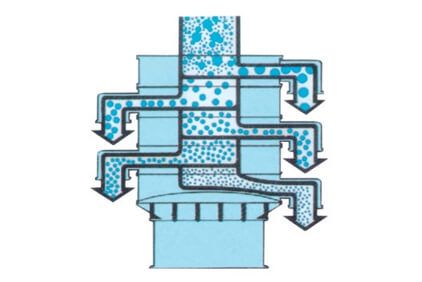
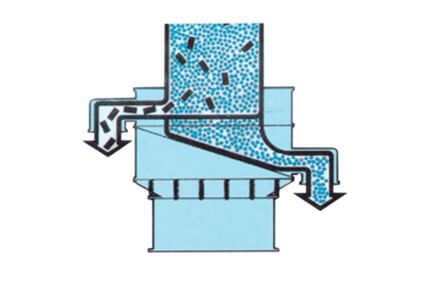
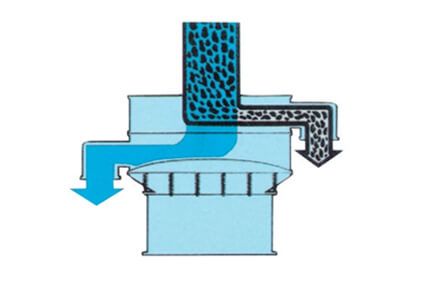
Use the S49 enquiry to define a circular vibrating-screen arrangement: which fraction passes the mesh, which outlet retains oversize, and how the feed reaches each deck. A request for several size grades needs a different fraction and outlet description from a final check before packing.
- Describe check screening or grading, rather than selecting on screen diameter alone.
- Show the feed route, retained fraction and downstream connections.
03
Separate check screening from classification
Removing occasional oversize before packing is a different duty from making several particle-size grades. For the S49 enquiry, describe which stream is the desired product and whether the screen receives a steady feed or intermittent bag tipping. The answer affects the proposed screen arrangement and discharge layout.
- Identify the incoming maximum lump size and any foreign material.
- Provide the aperture in a dimensional unit, with mesh standard if applicable.
- Show inlet and outlet connections, including their heights.
04
Review the feed and inspection points
A circular screen can be restricted by how material reaches and leaves it even when the nominal screen diameter looks adequate. Discuss feed distribution, upstream surges and downstream back-pressure. Access to inspect mesh and seals should be considered before the machine is placed between fixed connections.
- Distinguish an enclosed connection from a confirmed pressure-rated design.
- State cleaning frequency and product-changeover needs.
- Define an inspection and trial acceptance method for retained oversize.
05
When to review ultrasonic assistance instead
If loss of usable mesh area is the limiting issue, describe the deposits or near-aperture particles and compare the ultrasonic-assisted route. That enquiry adds screen, transducer and generator matching to the mechanical selection; it does not establish a higher output from the S49 model name alone.
CONFIGURATION REVIEW
Specify the machine for the task.
| Selection item | Information to confirm |
|---|---|
| Fraction and outlet arrangement | Identify the wanted pass fraction and retained oversize for each proposed deck; show where each stream goes. |
| Feed into the circular screen | Describe steady or intermittent feeding, upstream surges and inlet distribution before choosing the arrangement. |
| Mechanical installation reference | Use the S49 diameter, area and height tables to discuss the proposed drawing, connections and inspection access. |
| Acceptance of this separation | Agree the retained-oversize check and product requirement with the actual feed; catalogue size alone is not a throughput guarantee. |
Final technical values, dimensions and performance conditions are confirmed against the proposed equipment and application.
TECHNICAL DATA
Models & specifications
| Model | Effective screening diameter (mm) | Effective area (m²) | Decks | Vibration-motor power (kW) |
|---|---|---|---|---|
| S49-400 | 340 | 0.09 | 1–5 | 0.18 |
| S49-600 | 540 | 0.23 | 1–5 | 0.25 |
| S49-800 | 730 | 0.42 | 1–5 | 0.55 |
| S49-1000 | 900 | 0.64 | 1–5 | 1.1 |
| S49-1200 | 1100 | 0.95 | 1–5 | 1.1 |
| S49-1500 | 1400 | 1.5 | 1–5 | 1.5 |
| S49-1800 | 1700 | 2.3 | 1–3 | 2.2 |
| S49-2000 | 1886 | 2.8 | 1–3 | 2.2 |
Catalogue dimensions and options. The supplied configuration is specified in the quotation.
| Model | Single-deck height (mm) | Double-deck height (mm) | Triple-deck height (mm) |
|---|---|---|---|
| S49-400 | 670 | 770 | 870 |
| S49-600 | 740 | 850 | 960 |
| S49-800 | 850 | 980 | 1100 |
| S49-1000 | 850 | 980 | 1100 |
| S49-1200 | 955 | 1100 | 1245 |
| S49-1500 | 1000 | 1145 | 1290 |
| S49-1800 | 1250 | 1400 | 1550 |
| S49-2000 | 1250 | 1400 | 1550 |
Heights refer to the catalogue mechanical arrangement. Confirm the actual inlet, outlet and access requirements on the selected drawing.
A CLOSER LOOK
Equipment & Configuration Details
S49 Rotary Vibrating Screener
DISCUSS
YOUR TASK
Let's review the application.
Provide the material, separation target and process requirements so that the equipment configuration can be discussed.