
Begin with the actual family and configuration
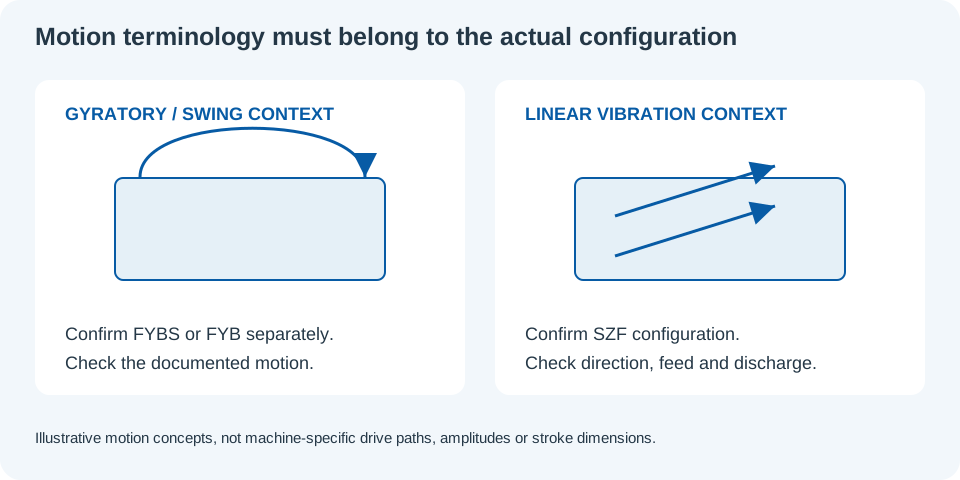
Use gyratory versus linear as a mechanism question, not as a ranking of rectangular machines. In the archived Zhenwei catalogue, FYBS and FYB are separately named families and SZF is the linear vibrating family. Do not silently collapse FYBS and FYB into one specification or infer interchangeability from a similar casing.
The initial choice depends on the grades you need, feed behaviour, installation and the confirmed motion of the offered model. This is a configuration comparison, not a matched throughput study.
Resolve FYBS, FYB and the offered motion before comparing numbers
Ask the proposal to identify the exact family, model, screen arrangement, outlets and movement description. Check which dimensions and operating terms belong to that model. A stroke, an amplitude and an overall motion description are not automatically interchangeable measures.
The archived FYBS table has ambiguities caused by merged cells. Public catalogue integration retains the clear model and area cells without guessing missing drive/deck values. This article therefore does not use those ambiguous cells to produce a numerical ranking.
| Series / question | Documented catalogue distinction | What still needs the actual drawing |
|---|---|---|
| FYBS example | FYBS1030: listed effective area 3 m² | Other drive/deck dimensions are resolved in the selected proposal |
| FYB example | FYB1000×1400: 1 deck; screen 1000×1400 mm | Separate 2FYB/3FYB catalogue entries show further arrangements |
| Comparison boundary | Catalogue area and nominal dimensions are not interchangeable performance results | Verify drawing, outlets and access before making a structural comparison |
Define whether the job is grading, scalping or material transfer
A process that needs several saleable fractions places different demands on collection and analysis from a process that only removes oversize. If material also has to move from one process to the next, specify the transfer interface rather than assuming every screen is an appropriate conveyor.
For the comparison, record the size boundaries, mass destination and quality criterion of every stream. Feed-size distribution, especially the amount near each opening, is part of the duty.
| Question | Gyratory-family review | Linear-family review |
|---|---|---|
| Which machine is being offered? | Confirm FYBS or FYB and its current configuration | Confirm SZF model and current configuration |
| Which fractions must be collected? | Check the actual decks and outlet arrangement | Check the actual decks and outlet arrangement |
| How is feed presented? | Review inlet distribution and the intended material path | Review bed distribution, movement and discharge |
| Which layout governs selection? | Height, access, connections and supporting requirements | The same installation boundaries for a fair review |
Use dimensions to solve an installation problem
Provide upstream and downstream equipment positions, permissible inlet height, discharge destinations, floor area and maintenance clearances. Include whether the installation is continuous, batch-based or changed between materials.
Check the relevant support and connection information against the proposed machine. This article is not a foundation design or an instruction for attaching rigid pipework to moving equipment. Those matters require the actual drawings and engineering review.
Investigate feed distribution before attributing a result to motion
A result can change because feeding became steadier or material spread differently, even if the screen setting did not change. Record actual feeding, accumulations and interruptions. Note whether the comparison includes start-up and transition periods or only a defined stable interval.
If one machine receives a different feed-size distribution, moisture condition or target fraction, its output cannot be treated as an isolated effect of gyratory or linear motion. Make those differences explicit.
Write a common acceptance plan
Where comparison is necessary, use a representative material batch, the same product fractions and the same analysis method. Measure all streams and elapsed time, then compare accepted-product output and composition together. Keep the exact configurations and any unavoidable differences in the report.
An unresolved family distinction or missing drawing is a limitation to record, not permission to fill a table from another machine. The current product pages are the place for catalogue values; the comparison should explain the selection decision without duplicating or contradicting them.
Source basis and what remains application-specific
The equipment-family descriptions come from archived Zhenwei FYBS, FYB and SZF pages. They do not establish a common test condition or a universal efficiency advantage. The movement diagram is an original decision schematic, not a measured motion path or proprietary drive drawing.
For an enquiry, identify the desired fractions and send the layout with the material description. Ask which family is being proposed and which drawing or trial will resolve remaining uncertainties.