
First resolve the word “rotary”
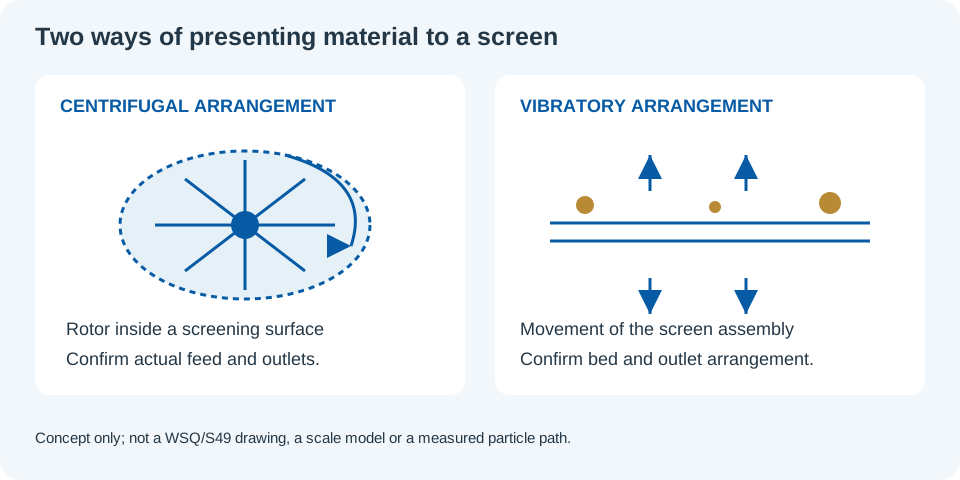
In this comparison, rotary sifter means a centrifugal arrangement with a rotor and a cylindrical screening surface, represented by the Zhenwei WSQ family. Vibratory screener means an arrangement in which vibration presents material to a screen, represented here by S49. Some suppliers also use “rotary vibrating screen” for a circular vibratory machine. Therefore “rotary versus vibratory” can otherwise compare a machine with itself.
The practical answer is to confirm the mechanism before comparing capacity, cleaning or suitability. This is a structural engineering comparison, not a matched performance test.
Follow how the material meets the screen
For a centrifugal arrangement, investigate the feed screw where fitted, rotor action, cylindrical mesh and separate product paths. For a vibratory arrangement, investigate the vibrating screen assembly, feed position, surface loading and outlets. The conceptual diagram identifies the two questions; it does not show a specific rotor clearance or an operating adjustment.
Ask for the current configuration drawing if rotor contact, access or internal clearance affects the material. A brochure photograph alone cannot establish those details.
Compare the two arrangements on useful selection criteria
This table describes questions to investigate for the proposed model. It does not assign a universal winner. Access, seal design and available options can vary within a family, and catalogue labels are not evidence that every configuration has the same features.
| Selection question | Centrifugal arrangement | Vibratory arrangement |
|---|---|---|
| How is material presented? | Rotor and feed arrangement inside a cylindrical screen | Movement of the screen assembly and the material bed |
| What might affect the material? | Rotor interaction, feed condition and internal clearances | Movement, residence behaviour and bed loading |
| What requires inspection? | Rotor, cylindrical mesh, seals and access arrangement | Mesh, tension, seals, decks and outlets |
| What proves useful output? | Accepted stream measured under stated conditions | The same accepted-stream and quality definitions |
Separate scalping from multi-fraction grading
Removing occasional agglomerates from a powder is not the same task as producing several narrow fractions. Define the role of the retained material: is it waste, rework or a valuable second product? Confirm how many streams the proposed arrangement can actually collect and whether the target fraction can be analysed consistently.
Do not assume that a rotor is a mill or that an increased fines fraction proves better separation. If the feed can break down, include a before-and-after size analysis and record whether the changed particles meet the intended product requirement.
Evaluate powder behaviour and contact requirements
For cohesive or fibrous feeds, observe what happens over time rather than judging the first clean-screen minute. Record feed stability, agglomerates, screen condition and interruptions. For fragile material, identify a damage measure before the test; visual appearance alone may miss a shift in size distribution.
Contact materials, temperature, seals, cleaning access and dust handling are configuration questions. Neither mechanism automatically provides hygienic validation, explosion protection or a particular containment level. Those requirements need their own documented assessment.
Ask what cleaning and inspection really involve
Request the relevant access and cleaning information for the actual model. Determine which components must be inspected, how product-contact areas are reached and which cleaning agents are permitted. Include the time and space needed to remove components when this is part of the authorised procedure.
Compare equivalent boundaries: opening a cover on one machine is not the same activity as a complete clean-and-inspect cycle on another. Without a consistent task definition and authorised maintenance record, a published “faster cleaning” percentage would be misleading.
Design a comparison that could change your decision
Use a representative batch, the same target aperture and the same accepted-product rule. Keep the actual feed rate and feed condition recorded, collect every stream and record elapsed time and interruptions. If two configurations cannot share an aperture convention or collection method, explain the difference rather than presenting one unqualified number.
A useful outcome can be a limitation: for example, the required quality may only be achieved at a lower accepted-product rate. Keep that trade-off visible in the equipment discussion instead of choosing the run with the highest instantaneous feed.
Questions to send with the equipment enquiry
State whether “rotary” means a centrifugal rotor or circular vibration in your enquiry. Attach a material description and ask the supplier to identify the offered mechanism explicitly.
- What is the accepted product, and how many fractions are required?
- Is particle damage, cohesion, fibre content or cleaning access a constraint?
- Which actual screen, rotor/deck and contact-material configuration is proposed?
- What trial records would establish the required quality and useful output?
Sources and reading limits
The equipment descriptions are based on archived Zhenwei WSQ and S49 material. The external references below help clarify terminology and mechanism; they do not validate Zhenwei throughput, provide a matched test or authorise reuse of another manufacturer’s drawings.