
Select the measurement system, not only the instrument
Choose a laboratory sieve shaker by starting with the sample, the analysis method and the sieve stack the method requires. Then confirm that the instrument’s documented movement, frame compatibility and permitted accessories fit that method. A laboratory sieve result is a sample-analysis result, not a rating of industrial screening throughput.
This guide addresses selection inputs for the laboratory, tapping and inspection instrument families in the Zhenwei catalogue. It does not claim that all families use the same motion or meet every test standard.
Keep the instrument, sieves and method distinct
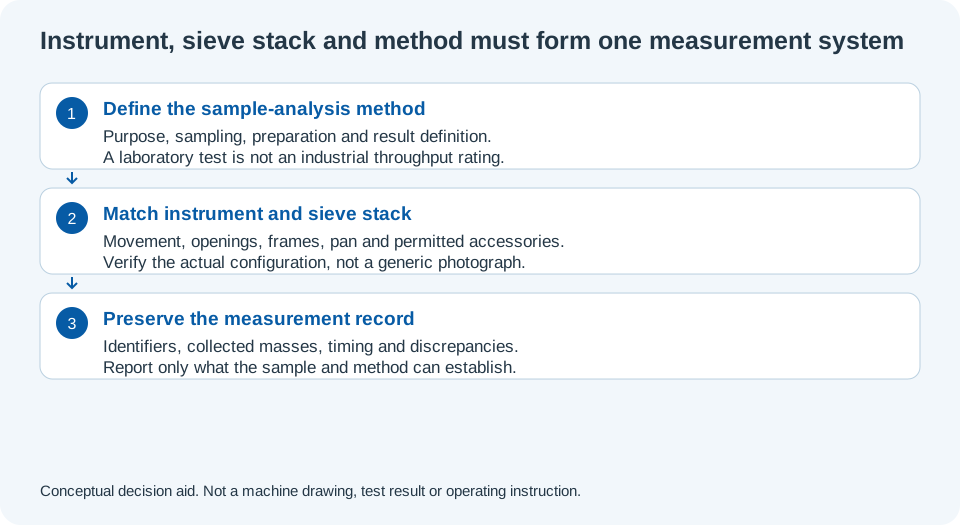
The instrument provides a documented movement and holds a compatible stack. The sieves provide defined openings and collection boundaries. The method defines sampling, preparation, test conditions, weighing and reporting. Each can be unsuitable even when the other two look appropriate.
The diagram is a relationship map, not a universal sieve-stack assembly instruction. The actual frame dimensions, stack arrangement, loading and operating procedure must come from the offered instrument and the applicable method.
Identify the sample and the purpose of the result
State whether the test is for process monitoring, batch acceptance, method development or another defined purpose. Record sample identity and representative sampling, material condition, particle-size range, moisture and relevant safety information. Ask whether the method needs dry or wet processing and whether that is actually supported.
Do not specify a fixed sample mass or duration from a general article. Those depend on the method, sample and instrument. An apparently stable final mass alone does not demonstrate that a procedure was appropriate.
| Selection layer | Information to confirm | Avoid assuming |
|---|---|---|
| Instrument | Documented motion, stack dimensions, permitted operation | All laboratory or tapping instruments are equivalent |
| Sieve stack | Openings, frames, identifiers and condition | A mesh label completely specifies a test sieve |
| Method | Sampling, loading, time/end point, weighing and calculation | One time or sample mass applies to every material |
| Accessories | Actual compatibility and authorised function | Wet or ultrasonic operation is included by default |
Confirm frame and accessory compatibility
Identify the required sieve-frame diameter, height, stack arrangement, lid/pan and instrument support or clamping information. Confirm how the actual equipment documentation addresses those items. Do not treat a photograph of a stack as proof of compatibility.
Ultrasonic assistance, wet-sieving arrangements and other accessories are conditional features. Verify them for the proposed instrument and material rather than importing options from an unrelated laboratory or industrial system.
Check measurement and verification requirements
Identify the required sieve specification and edition, where applicable, and the documentation needed for the frames and openings. Record sieve identification and condition, weighing equipment requirements and the reporting units. A standard number on a webpage is not a certificate for the supplied item.
If the result will be used for a contractual or regulated acceptance decision, the responsible laboratory must establish that the complete procedure and records are suitable. This guide does not replace that review or reproduce unverified clauses of a standard.
Plan how to report the sample result
Record the method, sample preparation, instrument and sieve identifiers, material condition, relevant settings/time boundary and mass retained in every sieve and pan. Retain the starting mass and any discrepancy rather than forcing a total to match by silently adjusting a fraction.
An illustrative calculation is not a validated test method. If there are repeat measurements or uncertainty estimates, record how they were obtained. If they are absent, do not imply repeatability or representativeness beyond what the sample and method support.
Use laboratory information carefully in production selection
A size distribution can help define the feed and target fractions for an industrial trial. It cannot by itself establish continuous accepted-product output, bed behaviour or the effect of production feeding and cleaning conditions.
Connect laboratory results to the sampling point and material batch used in the production discussion. If those differ, state the difference. This preserves the value of the sample analysis without turning a small-scale instrument test into a machine-capacity claim.
Source scope and an enquiry checklist
The instrument contexts come from archived Zhenwei laboratory, tapping and inspection equipment descriptions. The ASTM listing below identifies a test-sieve specification reference; its listing is not proof that the offered instrument or sieve conforms, and no inaccessible requirements are quoted.
- Sample purpose, method and material/safety information.
- Required openings, frame dimensions, stack and identification.
- Instrument motion and permitted accessories for the actual model.
- Weighing, record and verification needs.
- How the laboratory result will be used—and what it will not establish.
ASTM E11: verify the applicable sieve specification and documentation ↗