
There is no universal winner
For a YB tumbler versus an S49 circular vibrating screen, compare how the offered motion presents your material to the screening surface, how required fractions leave the machine and whether the arrangement fits cleaning and access requirements. A round housing is not a mechanism description.
This article is an engineering comparison for the two identified families. It does not establish that a tumbler is always gentler, that a vibrating screen always has greater output, or that either has been tested against the other on your material.
Compare the material path, not the outline of the housing
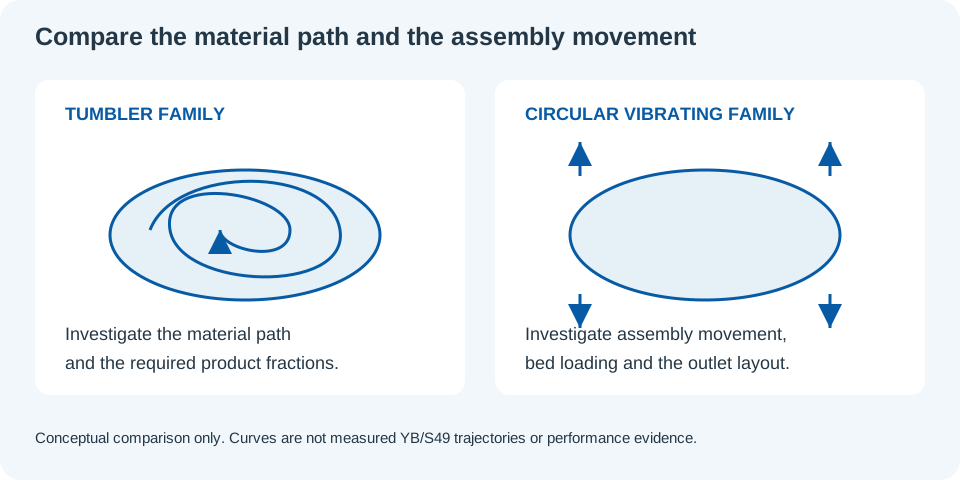
A tumbler arrangement is intended to create a defined material path associated with its motion and setup. In a circular vibrating arrangement, vibration and the assembly configuration govern the presentation and movement of the bed. The exact path depends on the offered machine and settings.
Use the current model information to establish how feed spreads, where useful separation takes place and how each outlet is connected. The schematic is a comparison checklist; it does not claim to reproduce a measured particle trajectory or a manufacturer-specific drive geometry.
Make product fractions the centre of the comparison
If you need several saleable grades, specify all boundaries and collection streams. If you only need to remove occasional oversize, do not judge the equipment against an unrelated narrow-fraction task. Near-aperture material can make the separation more demanding, which is a reason to characterise the feed rather than select by housing diameter alone.
| Decision input | Why it matters | What to request |
|---|---|---|
| Number of saleable fractions | Defines decks, outlets and sampling needs | A proposed stream layout for the actual grades |
| Near-aperture content | Affects the task at the selected opening | Representative feed-size analysis and aperture convention |
| Damage-sensitive material | Separation and breakage can be confused | An agreed before/after damage or size-analysis method |
| Cleaning and access | Can govern practical suitability | Current access arrangement and permitted cleaning method |
Test the “gentle handling” assumption
If preserving particles matters, define what damage means for that product. It might involve a change in size distribution, fractured granules or another application-specific measure. Record the feed condition before the trial and analyse the collected streams afterwards.
Differences between samples can otherwise be mistaken for machine-induced damage. A softer-sounding motion description is not proof of lower breakage, and a photograph of intact particles is not a substitute for a defined measurement.
Check configuration and installation details
For each proposed family, review the mesh assembly, usable fractions, seals, product-contact materials and any authorised cleaning assistance. Identify the feed arrangement, outlets, available height and space needed for access. Do not assume every optional configuration shown for one model is offered across the whole family.
For hygiene, containment and hazardous materials, state the actual requirements separately. Neither “tumbler” nor “vibrating” certifies the construction or validates a cleaning process.
Compare useful output under a common quality rule
Use a representative material batch, defined apertures and the same accepted-product criterion. Record the mass and analysis of every collected fraction, actual feed, elapsed time and interruptions. Where configurations necessarily differ, keep the differences visible in the report.
A machine may give higher feed throughput while producing a fraction outside specification. Another may meet quality at a different operating condition. Compare those trade-offs directly; do not publish a universal multiple of capacity or efficiency from a single catalogue or unmatched run.
Send a decision brief rather than only a preferred machine name
Include the fractions you need, the condition of the feed and the installation drawing. Explain whether damage, cleaning time, frequent product changes or stable continuous operation drives the decision. If there are competing objectives, rank them before testing.
The YB and S49 product pages hold the current catalogue information. Use those pages for model questions and use a material trial to resolve the part of the decision that a catalogue cannot establish.
Source basis and exclusions
This comparison uses archived Zhenwei YB and S49 descriptions to identify the equipment families. The selection matrix is original explanatory content. No matched YB/S49 dataset, measured trajectory, cleaning-time study or breakage result is available in the material used for this article, so none is claimed.