
CHEMICAL PROCESSING
Screening for chemical processes
Powder flow, particle-size targets and process conditions help determine the screening arrangement.
What needs to be separated?
Powder flow, particle-size targets and process conditions help determine the screening arrangement.
- Powder and granule classification
- Oversize removal
- Feed and process integration
Conditions that affect the selection
Describe moisture, agglomeration, abrasiveness, temperature and chemical compatibility. Any special containment or safety requirement needs an explicit engineering review.
Describe chemistry as well as particle size
Provide the material identity, safety data and process state before a technical recommendation. Abrasive fillers, soluble salts, cohesive additives and reactive powders can create different mechanical and material-contact constraints. Chemical compatibility and any containment, hazardous-area or atmosphere requirement must be confirmed for the actual assembly.
Choose by the process checkpoint
| Process task | Candidate route | Selection and evidence boundary |
|---|---|---|
| Dry filler or formulated-powder grading | Compare YB/S49/SZF by the required fractions | Chemical identity, moisture and abrasion |
| Fine cohesive powder | Diagnose restriction before ultrasonic assistance | Matched mesh, contact materials and any specialist protection |
| Reactive or hazardous powder | Begin with acceptance and engineering scope | Standard catalogue equipment does not establish inert or hazardous-area capability |
Calcium sulfate, fertilizers and formulated powders
A calcium-sulfate request should identify the process form, moisture, agglomerates, abrasiveness and required grade. Compare the aperture, near-cut fraction and sustainable loading before choosing a large screen. A material name and machine diameter do not establish capacity.
- For phosphate fertilizers or formulated detergents, identify chemistry and the desired granule/powder fractions. Corrosion, dust and cleaning must be checked for the actual contact assembly.
- Reactive or recovered battery powders require an explicitly accepted handling and documentation scope; do not treat all chemical powders as equivalent.
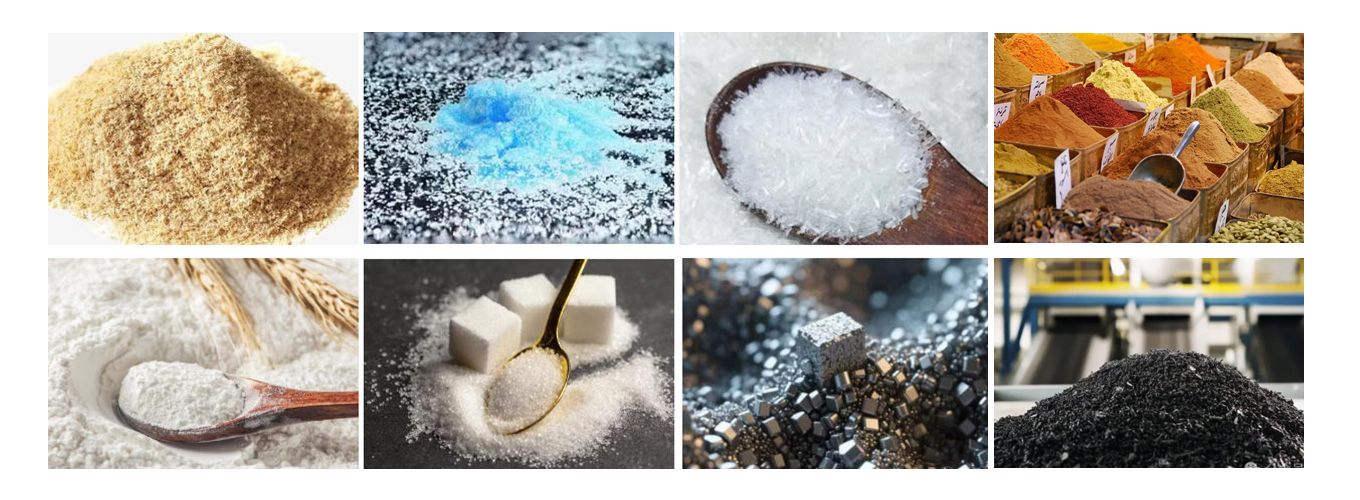
MATERIALS IN THIS INDUSTRY