
Start with the product you need to collect
Choose an industrial sifter by defining the accepted product first. “Sift this powder” does not say whether you need to remove occasional lumps, produce several saleable grades or recover a valuable fraction. Those are different duties, even when the machines look similar. State which outlet contains the useful product and how its quality will be checked.
This guide is an engineering specification method, not a ranking of machines or a report of a Zhenwei trial. It applies to early equipment selection for powders and granules. Liquid-containing feeds and hazardous materials require additional application review.
Use four gates before choosing a model
Move from the separation objective to the feed condition, then to the process interfaces and finally to an acceptance plan. A gate may end with an unanswered question rather than a machine recommendation. For example, an unknown particle-size distribution is a measurement to obtain; it is not a reason to guess a larger screen.
Do not start by comparing motor power across unrelated mechanisms. Power describes part of the equipment configuration, while useful output depends on the material, aperture, feed presentation and quality requirement together.
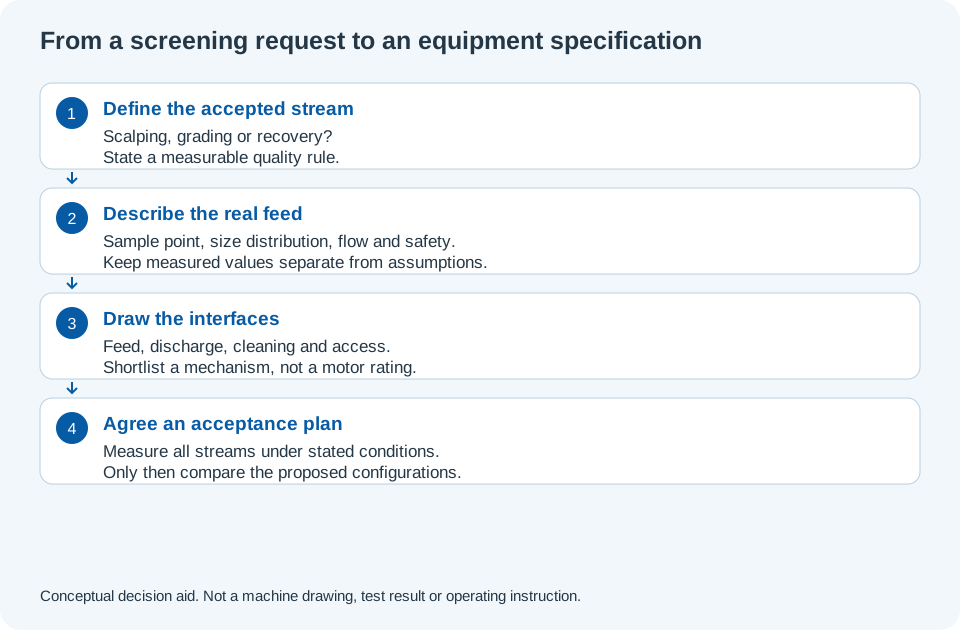
Translate the duty into a measurable requirement
Write the separation in a way that another person could check. For scalping, identify the unwanted oversize and the tolerated carry-over. For grading, define every required fraction and its destination. For product recovery, define which particles are valuable and how you will distinguish recovery from contamination.
Use dimensional aperture units and identify the measurement method. A sieve result from a laboratory sample can help describe the feed, but it does not establish continuous production capacity.
| Duty | What to specify | What to measure |
|---|---|---|
| Check screening | Unwanted fraction and permitted carry-over | Accepted-stream composition and interruptions |
| Multi-fraction grading | Size boundaries and destination of each grade | Mass and size analysis of every collected fraction |
| Product recovery | Valuable component and acceptable contamination | Recovery and purity using a defined analysis method |
Characterise the material at the actual screening point
A sample taken before grinding, drying or pneumatic transfer may not represent the feed that reaches the screen. Record where and when it was collected, whether it includes routine lumps and whether storage changes its flow. Describe particle-size distribution, moisture condition, bulk density, temperature, fibres, agglomeration and sensitivity to damage.
Treat safety information as a separate input. A familiar industry label does not establish dust explosibility, toxicity or compatibility with cleaning chemicals. Where these properties are unknown, request assessment before selecting a standard configuration.
- Record the normal range, not only the easiest batch.
- Separate observed behaviour from estimates and supplier assumptions.
- Identify which properties were measured, by which method and on which sample.
Shortlist mechanisms by the question each must answer
A tumbler, a circular vibrating screen, a linear screen and a centrifugal sifter do not become interchangeable because all can contain a mesh. Compare how feed is presented, the path across the screening surface, rotor contact where applicable, access for inspection and how separated streams leave the machine.
Use the shortlist to define a trial question. If the material damages easily, ask how damage will be measured. If throughput falls over a run, investigate bed loading and aperture obstruction rather than assuming more installed power will solve the cause.
Specify the installation and cleaning interfaces
Provide a simple layout showing upstream equipment, inlet position, outlet destinations, available height and maintenance space. Describe whether feeding is steady or intermittent and whether the screen has to operate against pressure or vacuum. Include power supply and the surfaces that contact product.
For cleaning, state the actual medium, temperature, concentration and required access. Do not replace these inputs with “food grade” or “pharmaceutical grade”: those phrases do not define a material certificate, a cleaning procedure or a certified machine configuration.
Agree the acceptance method before accepting a quotation
Define an accepted-product rate, an analysis method and a period that includes representative operation. Record feed and all collected streams, configuration changes and interruptions. If a comparison is needed, hold the sample, aperture and quality rule constant. A high feed rate with an unacceptable fraction is not a successful screening result.
Retain missing measurements and unsuccessful runs in the report. A proposal can be conditional on resolving these points; it should not convert an incomplete laboratory demonstration into a continuous-duty guarantee.
A brief you can send with an enquiry
Send a concise process brief with the information below. “Unknown” is useful when accompanied by a question about how to establish the value. It is more useful than a precise-looking number borrowed from another powder.
- Material, sample point and applicable safety information.
- Accepted fraction, rejected fraction, aperture units and quality test.
- Required accepted-product output and operating pattern.
- Feed/discharge layout, available space, cleaning and product-contact requirements.
- Proposed sampling, trial records and acceptance limits.
Evidence basis and the next decision
The mechanism descriptions use Zhenwei’s archived equipment catalogue as a starting point. The workflow and comparison questions are original decision aids; no anonymous customer record or comparative performance result is being presented. Go to the equipment overview to explore actual series, or use the trial-planning guide to define a test before discussing a configuration.