
Mesh count alone does not define an opening
Specify the opening in a dimensional unit and identify the construction before ordering a screen. For an ideal square plain weave, opening depends on both mesh count and wire diameter. Two meshes described by the same count can therefore have different nominal openings.
A micron, or micrometre, is a unit of length; mesh count is a counting convention. Neither a count-to-length calculation nor a supplier’s conversion list proves a test-sieve tolerance, particle-retention rating or compliance with a standard. This guide explains geometry and purchasing inputs, not certification.
WORKED GEOMETRY
Check a mesh and wire combination
For an ideal square plain weave: opening = 25.4 ÷ mesh count − wire diameter. This is geometry, not a test-sieve tolerance or filtration-retention certificate.
Default inputs reproduce a combination in the existing wire-mesh catalogue. No data is sent or stored. Not applicable to Dutch weave, perforated plates or an undefined mesh convention.
Keep pitch, wire and opening separate
For the idealised square plain-weave relation used here, pitch is the distance from one wire centre to the next. A nominal opening is what remains after subtracting the wire diameter from that pitch. The worked geometry assumes a consistent repeats-per-inch mesh convention and straight, evenly spaced wires.
It does not describe Dutch weave, perforated sheet, wedge wire or other constructions. Those require their own dimensional and performance descriptions; do not apply this relationship simply because a product is called a screen.
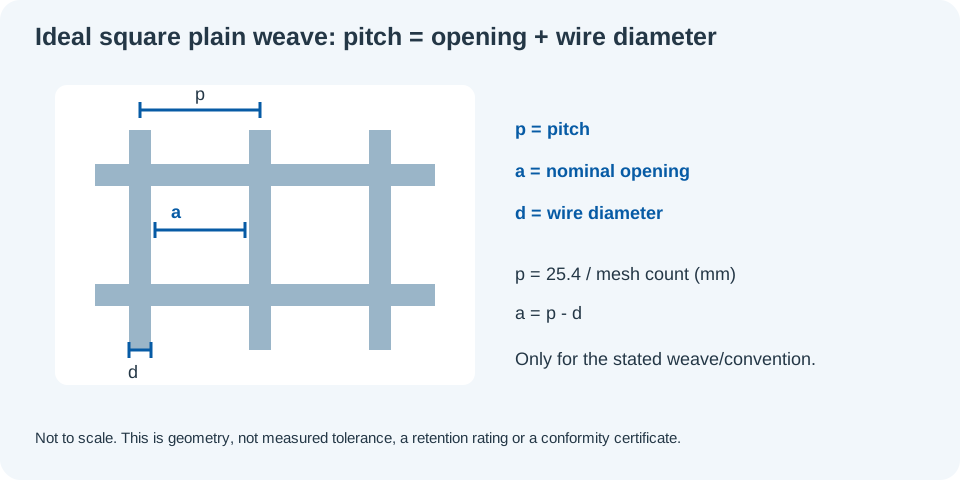
A worked example from the archived mesh catalogue
Under the stated ideal-square-weave convention: pitch = 25.4 mm ÷ mesh count; nominal opening = pitch − wire diameter. For 100 repeats per inch and 0.10 mm wire, the calculation is 0.254 − 0.10 = 0.154 mm, or 154 µm. The interactive calculator below reproduces this geometry; it does not measure an installed mesh.
This example is based on a combination present in the archived Zhenwei wire-mesh catalogue. It is a nominal calculation, not an acceptance inspection, and it should not be used as a substitute for the exact product specification.
| Quantity | Example value | Meaning |
|---|---|---|
| Mesh count | 100 repeats per inch | Assumed counting convention for this example |
| Pitch | 0.254 mm | 25.4 ÷ 100 |
| Wire diameter | 0.10 mm | Input, not inferred from mesh count |
| Nominal opening | 0.154 mm = 154 µm | Ideal pitch minus wire; no tolerance is established |
Two catalogue rows show why count is not enough
The archived Zhenwei catalogue lists two 100-count combinations: 0.10 mm wire with a 0.154 mm opening, and 0.14 mm wire with a 0.114 mm opening. They share a count but not an opening. This is a concrete reason to request both dimensions.
The open-area values below are original calculations for an ideal square plain weave: (opening ÷ pitch)² × 100. They are not measured tolerances, structural-strength values, screening-efficiency results or rated throughput. The calculation cannot establish the weave quality or condition of a supplied panel.
| Catalogue count | Wire diameter | Listed opening | Calculated ideal open area |
|---|---|---|---|
| 100 per inch | 0.10 mm | 0.154 mm | 36.8% |
| 100 per inch | 0.14 mm | 0.114 mm | 20.1% |
Use impossible combinations as a warning
The pitch calculation gives a useful consistency check. If wire diameter equals or exceeds the pitch, no positive nominal opening remains under this model. That is a reason to check the source, units and convention, not to silently replace the number with a more plausible value.
One archived catalogue row combines 400 mesh, 0.25 mm wire and a positive aperture. Those values are inconsistent under the stated relationship, so the row is omitted from the public parameter table while the raw source is retained. It has not been “corrected” by guessing the intended wire diameter.
Separate industrial screening mesh from a test sieve
Industrial mesh selection includes opening, construction, material, tensioning, support and compatibility with the machine. A laboratory test sieve additionally belongs to a specified measurement method and sieve specification. Frame dimensions, identification and verification records can matter to the result.
ASTM E11 and ISO 3310 are relevant reference families for appropriate test sieves, but naming them is not a claim that a particular supplied sieve complies. Confirm the applicable part, edition, construction and verification documentation. The full requirements are not reproduced or inferred from an inaccessible standard page.
An opening is not a guaranteed particle cut
Particle shape, orientation, distribution, agglomeration, loading and residence conditions can influence what passes. A long or irregular particle does not behave like a perfect sphere with one diameter. The useful product specification should therefore name the analysis method and acceptance rule rather than equate a nominal opening with perfect separation.
If the target is a product-size distribution, test the collected stream. If it is retention of a contaminant, define that contaminant and the allowable carry-over. These are different measurement questions.
What to include when requesting mesh or sieves
Send the details below, together with the model or sieve method. If the existing item only has a mesh label, obtain the missing dimensions instead of treating the label as a complete specification.
- Opening and wire diameter, units, weave/construction and material.
- Panel/frame dimensions, fastening, seal and support details.
- The machine model or laboratory method and compatible sieve stack.
- Required identification, tolerance or verification documentation.
- Material, cleaning exposure and the product acceptance method.
References and calculation limits
The nominal example comes from archived Zhenwei mesh data; an inconsistent row is explicitly excluded. ASTM’s specification listing is a reference to scope, not a quotation of verified clauses or evidence of product conformity. No universal mesh-to-micron table, filtration rating or test-sieve certificate is generated here.
ASTM E11: specification listing; verify the required edition and supplied documentation ↗