
Agree the question before sending material
Prepare a screening test by identifying the decision it should support: a fraction, an accepted-product rate under a quality rule, an obstruction problem or a comparison between permitted configurations. Then agree sample requirements and the proposed work with the receiving team. Shipping an unexplained bag does not define a useful trial.
This is a preparation method, not a booking confirmation, a sample-acceptance policy or a promise that Zhenwei can handle every material. No fixed sample quantity, completion time, cost or return arrangement is invented here.
Keep the chain from sample to decision intact
Connect the process sampling point, the material identity, the agreed test conditions, the measurements and the equipment decision. A break in that chain limits what the result can establish. For example, a sample taken before a drying stage may not represent the feed actually supplied to the production screen.
The flowchart is a planning aid. It does not represent a completed customer trial or an approved shipping route.
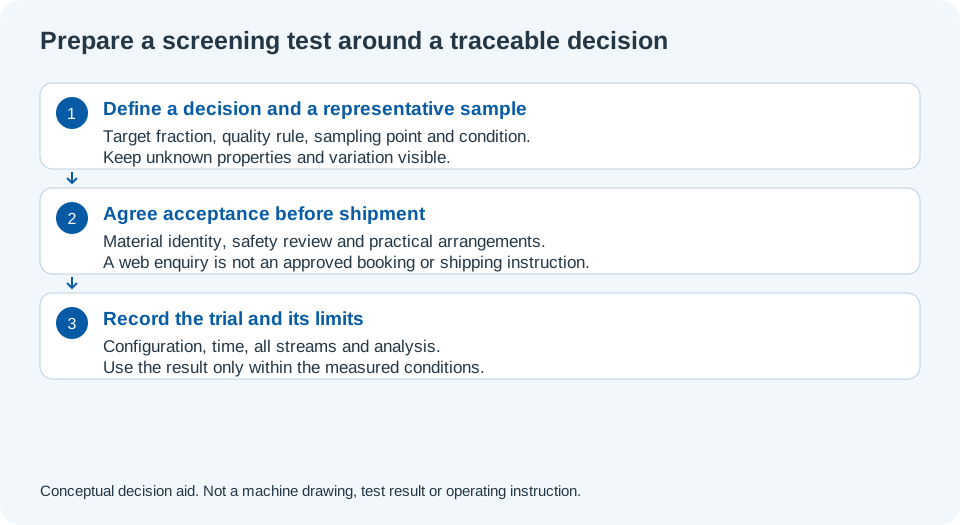
State the accepted product and every relevant output
Describe the desired fraction and what is rejected, recovered or collected as another grade. Specify aperture units and the method used to assess the product. Include the output target only together with the required quality and operating boundary.
If the issue is blockage, describe the symptom and when it occurs. If it is material damage, define a way to assess damage. Avoid changing the objective after seeing a result; an altered objective should be recorded as a new question.
| Preparation area | Information to agree | Do not assume |
|---|---|---|
| Trial question | Fraction, quality rule and decision to be made | A feed-rate demonstration answers every question |
| Sample | Process point, batch, condition and representativeness | A convenient sample represents all production |
| Safety and acceptance | Identity, SDS where relevant, handling and approval | The receiver can accept an unknown or hazardous powder |
| Method and records | Configuration, timing, all streams and analysis | A photograph or one passing mass is a complete report |
| Practical arrangements | Quantity, shipment, fees, timing and disposition by agreement | Fixed kilograms, days or automatic return |
Explain where the sample came from
Record material name and batch, sampling point, date and conditions, and any known variation in particle-size distribution, moisture, bulk density or agglomeration. Describe transport or storage conditions that could change it. Do not remove difficult lumps from the sample unless the agreed method specifically requires that preparation.
Ask the receiving team how much representative material is needed for the proposed configuration and test plan. The answer depends on the duty and planned measurements; a generic minimum would create false certainty.
Obtain acceptance and shipping instructions first
Provide material identity and relevant safety information, including an SDS where applicable, and disclose known hazards or special handling needs. Do not send an unknown, hazardous or restricted material until the receiving party has explicitly confirmed whether it can accept it and under what arrangements.
Shipping, packaging, labelling and legal requirements depend on the material and route. This article does not approve transport or provide a hazardous-goods packing procedure. Agree responsibility, permissible handling and sample disposition with the actual parties.
Agree what the test record must contain
Record the material and preparation, offered machine and configuration, mesh and opening convention, permitted settings, actual feeding, timing boundaries and interruptions. Collect and identify all output streams, then record mass and any required composition analysis.
For a comparison, identify which conditions are held constant and which vary. The responsible technical team should define repetitions and safe operating bounds. Where a proposed measurement cannot be made, state the limitation before presenting the result as an answer.
Agree practical arrangements without confusing them with results
Confirm quantity, receiving contact, schedule, charges if any, sample consumption or return/disposal, report scope and permitted publication. An enquiry received through the website is a request for discussion, not proof that a trial date or sample acceptance has been confirmed.
Keep confidential customer or material information out of public reports unless publication is authorised. A model photograph, a signed delivery note and a measured performance result are different records and should not be substituted for one another.
Use the result to make the next decision
Assess accepted-product rate and quality together, with the material and conditions attached. Keep discrepancies, interruptions and negative findings visible. The outcome may support a proposed configuration, call for another sample or show that a different process question must be answered.
Do not extrapolate beyond the evidence: a limited sample test is not automatically a continuous production guarantee, a different material approval or an entire-family performance claim. Record the boundary in the proposed next step.
Evidence basis
This is an original preparation checklist linked to the site’s manual application-review workflow. It does not reproduce a verified enterprise sample-acceptance SOP, laboratory accreditation, customer test report or hazardous-material capability. Those require actual agreement and documentation. Use the testing enquiry route to discuss the proposed question before arranging shipment.