Diagnose the restriction before prescribing a device
A falling passing rate does not by itself prove screen blinding. Check whether the restriction comes from lodged particles, a coating, agglomeration, uneven feeding, excessive bed loading or a damaged assembly. Cleaning assistance should address a documented mechanism and must be compatible with the actual screen.
This is a diagnostic planning guide, not an instruction to inspect moving equipment or alter an installed machine. Use the site’s authorised isolation and inspection procedure. No cleaning system is claimed here to eliminate every form of blockage.
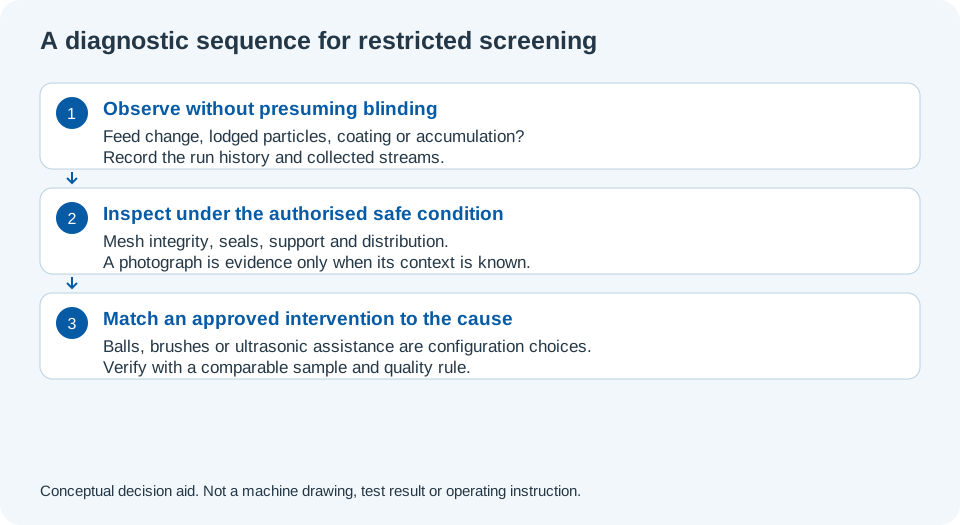
Connect three observations: feed, screen and collected streams
Start with the feed condition and actual feed rate, connect them with the condition of the safely inspected screening surface, then analyse the outlets. A snapshot of the mesh without a run history can hide when a problem started. Likewise, a reduction in output can reflect a change in material rather than a change in screen condition.
Label photographs with machine, aperture, material batch, location and inspection time. Do not substitute a generated “blocked screen” image for a real diagnostic record.
Classify the symptom without treating a hypothesis as a fact
The table suggests discriminating questions. It does not diagnose a particular machine remotely. More than one mechanism can be present, so record uncertainty and test explanations separately.
| Observed symptom | Possible explanation to check | Distinguishing information |
|---|---|---|
| Particles remain lodged in openings | Near-aperture pegging | Feed-size distribution, opening and close inspection |
| A layer adheres across the surface | Moisture, cohesion, static or a product deposit | Batch condition, cleaning exposure and environmental history |
| Material accumulates without obvious plugged openings | Feed distribution or loading restriction | Actual feed, bed distribution and outlet behaviour |
| Coarse material appears in the accepted stream | Mesh, seal or assembly fault | Authorised integrity inspection and stream analysis |
Eliminate feed and integrity faults first
Check the material at the screening point, including changes in moisture or lumps after storage. Compare the actual feed pattern with the intended operation and note whether material is distributed across the useful surface. Review the condition of mesh, support, tension and seals using the relevant machine procedure.
If there is a damaged screen or an incorrect assembly, restore the specified arrangement before judging a cleaning option. Increasing excitation or introducing a brush cannot turn a leaking seal into a valid separation.
Evaluate cleaning assistance against the confirmed mechanism
Elastic balls act through an authorised supporting arrangement; brushes involve their own contact and wear considerations; ultrasound requires a compatible mesh and transmission system. The choice therefore includes construction, product-contact suitability, permitted settings, cleaning and inspection—not just a device name.
Ask which observation supports the proposed option. A comparison should also consider whether the option changes product contamination risk, wear, access or cleaning requirements. Do not retrofit unapproved components or infer compatibility from an illustration.
Run a controlled verification after an authorised change
Define a before/after question and a quality rule before testing. Use comparable material and a documented feed condition, record the screen configuration and collect all streams over a stated period. Include interruptions and observations made after safe stopping.
If feed condition, aperture and assistance all change together, the result cannot isolate the effect of one component. Record that limitation. A useful report may support a configuration for one material range without proving a universal anti-blinding claim.
Keep a fault log that a second person can use
A practical fault record connects what happened with the conditions in which it happened. Use consistent timing and images rather than a collection of unlabelled close-ups.
- Machine/model, mesh identification, aperture and material batch.
- Actual feed and product conditions before the restriction appeared.
- Symptom, affected location, photographs and safe inspection record.
- Authorised change, time, settings and any new wear or deposits.
- Accepted/oversize masses, analysis, interruptions and unresolved questions.
Source basis and when to ask for an application review
The option descriptions use archived Zhenwei mesh, cleaning-ball and ultrasonic equipment material as catalogue context. The diagnostic sequence is original; it does not claim a verified fault history from an unnamed customer or provide machine-specific repair instructions.
Use the ultrasonic guide if mesh assistance is a credible test question. Use the mesh page to identify a replacement specification. If the material is hazardous or the cause is uncertain, stop short of an unsupported retrofit recommendation and seek a model-specific review.