This is a preparation checklist, not a replacement procedure
Before any screen-mesh replacement, identify the machine, the installed assembly and the manufacturer’s current authorised procedure. Only competent, authorised personnel should carry out the work under the applicable site safety arrangements. A general webpage cannot supply the model-specific isolation, access, tensioning, fastening or return-to-service instructions.
The available material does not include a verified model-specific Zhenwei maintenance procedure with step photographs. Therefore this article explains what information to assemble and what the responsible team must verify; it deliberately gives no dismantling sequence, torque value or improvised safety step.
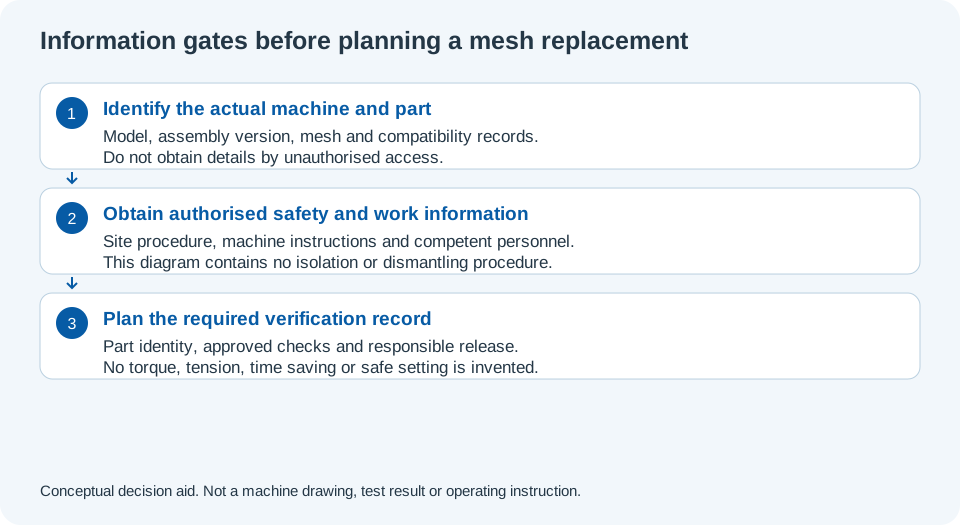
Make four information gates visible
The preparation gates are identity, authorised safety/procedure information, part compatibility and the required inspection/return-to-service record. An unanswered gate means more information is needed; it is not an invitation to improvise.
The schematic contains no operating steps or representation of a machine’s safety system. It is not a substitute for the employer’s hazardous-energy control programme or the actual machine instructions.
Identify the machine and existing mesh assembly
Record model, serial/asset identification where available, deck position, existing mesh identification, aperture and construction. Include frame or panel dimensions and the relevant fastening, seal and support details from the approved documentation. Do not infer compatibility merely from a similar screen diameter.
Photographs can support identification when safely obtained, but should not require opening or entering equipment outside the authorised procedure. Never use a generated image as evidence of an actual installed component.
| Preparation subject | Information to obtain | Why a generic guide is insufficient |
|---|---|---|
| Machine identity | Model, asset/serial and relevant assembly version | Configurations can differ within a family |
| Replacement specification | Opening, wire/construction, frame, fastening and seal | A count or outer dimension alone may be incomplete |
| Authorised procedure | Current machine instructions and site safety requirements | Isolation, access and adjustments are model/site-specific |
| Inspection and release | Responsible personnel and required record | Installation is not verified by appearance alone |
Obtain the actual safety and work instructions
Identify all relevant energy and process hazards through the responsible site procedure. The required isolation, verification, access arrangements, protective measures and competence must be determined for the machine and site—not invented from a stock diagram.
OSHA 1910.147 is cited below as a United States hazardous-energy-control reference. Applicability depends on the jurisdiction and work. The citation does not make this checklist a complete compliance procedure or establish that a particular machine’s hazards have been assessed.
Confirm replacement compatibility before scheduling work
The responsible technical or spare-parts team should confirm aperture, wire/construction, material, frame dimensions, fastening and seals against the actual model. If cleaning balls, supports or ultrasonic components are involved, their compatibility belongs in that review.
Keep a record of approved substitutions and unresolved differences. A replacement with the same apparent mesh count may have a different opening or construction; a replacement with the same frame size may still have an incompatible interface. Do not improvise fitting or tensioning instructions.
Define the inspection record without inventing acceptance values
The relevant instructions and responsible personnel must determine checks of installation, integrity, seals, fasteners, tension where applicable, cleanliness and return to service. This article does not provide acceptance values or tell a user how to run those checks.
Record the removed and installed part identifiers, reason for replacement, approved procedure/version, authorised personnel and the result of required inspections. Retain any defect or unresolved issue rather than closing the record simply because the new part is in place.
Avoid unsupported maintenance-efficiency claims
If authorised work is later studied, define exactly which task is timed, who performs it and which steps and inspections are included. A quick removal demonstration is not equivalent to a complete safe replacement and release cycle.
There is no verified Zhenwei replacement-time dataset in this article. No “tool-free,” fastest-change, downtime saving or percentage improvement is inferred from photographs. Such claims would require a specific arrangement, documented procedure and comparable records.
What to send when requesting the correct part
Provide the following without undertaking unsafe access merely to answer a website form. Where a detail is missing, ask the supplier and responsible site team how to identify it from existing records.
- Machine model and relevant asset/serial or configuration record.
- Current mesh/assembly identification and the required separation duty.
- Approved dimensions, aperture, construction, material and mounting details.
- Relevant seals, supports or compatible cleaning components.
- The maintenance documentation reference and the unanswered compatibility question.
Reference and publication boundary
This page is limited to information preparation because model-specific instructions and authorised step photographs are not present in the available evidence. It must not be represented as an operating or repair guide. The parts and quality pages provide the next route for identification and documentation questions.
OSHA 1910.147: control of hazardous energy; applicability and site procedure must be determined ↗