Start with a transfer duty, not a screw diameter
Select a screw conveyor by defining the material to be transferred, the route, required operating pattern and the interfaces at each end. Then confirm the actual structural and drive configuration with the supplier. A catalogue diameter alone does not establish capacity, power, permitted inclination or suitability for a difficult powder.
This is a selection-input guide based on the Zhenwei screw-conveyor product context. It does not size a drive, specify a support span or confirm that every flexible, shaftless or hygienic configuration is offered.
Draw the feed point, route and receiving process
Show inlet and outlet positions, elevation changes, route length, available space and access. Identify the supplying hopper or process and the receiving machine, including whether either interface imposes pressure, vacuum or a restricted discharge condition.
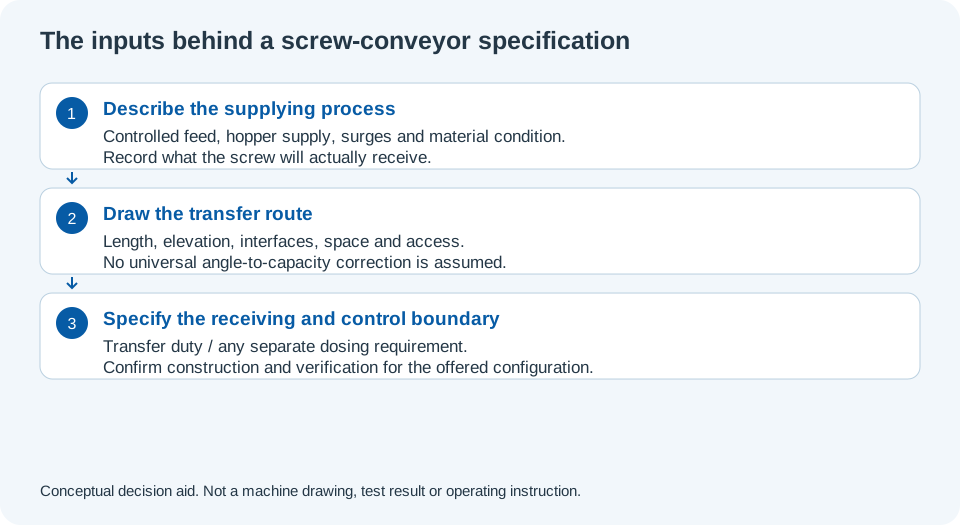
The conceptual diagram is a process-input map, not a fabrication drawing. A proposed route still needs the relevant mechanical, support, electrical and safety assessment for its actual configuration.
Explain how the material reaches the screw
Distinguish a controlled feed from material presented by a hopper or another process under its own flow conditions. Describe surges, interruptions and changes in bulk condition. The feeding boundary affects the proposed arrangement and should not be hidden behind one average hourly quantity.
Record particle-size range, bulk density as actually measured where available, moisture, cohesion, abrasion, fragility, temperature and safety information. Name any unknown property and how it will be established rather than copying a value for a different powder.
| Input | Why it affects the review | Useful evidence |
|---|---|---|
| Material condition | Flow, loading, wear and product preservation | Representative sample and relevant measurements |
| Feed boundary | The screw may see steady, intermittent or changing supply | Hopper/process description and actual feed behaviour |
| Route and inclination | Changes the transfer and installation question | Dimensions, elevations and allowed access |
| Receiving interface | Discharge conditions may constrain operation | Outlet details and receiving-process requirements |
| Cleaning and maintenance | Can determine construction and access | Permitted cleaning approach and service requirements |
Separate conveying from dosing
Moving material between points and delivering a measured dose are different tasks. If the process needs controlled feeding or dosing, specify the required range, control response and how delivered mass will be measured. A variable-speed motor by itself does not establish a dosing accuracy.
Describe what happens during start-up, shutdown, surges or a downstream interruption. Ask for the proposed control and interlock boundary rather than assuming it is included in the mechanical conveyor.
Do not apply a universal inclination correction
Route, material behaviour, feed condition and the actual conveyor design interact. A general “capacity loss per degree” curve would be unsupported here. Confirm the proposed inclination and configuration against the material and the manufacturer’s actual engineering information.
Where a trial or prior application record is used, identify the material, route and operating conditions. Do not treat a horizontal catalogue figure as a guaranteed inclined transfer rate or extrapolate from another screw construction.
Specify contact parts, sealing and service access
Identify product-contact materials, cleaning exposures, relevant sealing or containment needs and the access required by the authorised maintenance procedure. Ask which wear or support components are actually included and how their compatibility is identified.
For hazardous material or regulated production, request the relevant configuration assessment and documentation. “Enclosed” does not mean a particular containment, explosion-protection or cleanability standard has been established.
Send an enquiry that can produce a meaningful proposal
Combine the route drawing with the material and operating inputs. Keep the duty and acceptance rule visible when reviewing a proposal; the purpose is not to fill every box with a guessed value.
- Material, representative condition and safety information.
- Required transfer duty, operating pattern and whether dosing is a separate requirement.
- Actual inlet supply, outlet conditions and route dimensions/elevations.
- Contact-material, cleaning, sealing and access needs.
- Electrical/control interfaces and how useful transfer will be verified.
Catalogue and evidence limits
The archived Zhenwei screw-conveyor page supplies the product-family context. This guide supplies an original specification checklist rather than a new nominal size chart. It does not publish unverified drive calculations, a capacity-versus-angle curve or a claim that unsupported configurations are available.
Use the screw-conveyor product page for the current catalogue discussion, and the feeder comparison if the unresolved issue is controlled feeding rather than transfer.