Neither grade is a universal answer
Choose the stainless-steel specification for sieving equipment by identifying the actual exposure and the parts it affects. Product, cleaning chemicals, concentration, temperature, contact time and fabrication details can matter. Calling an application “food” or “pharmaceutical” does not by itself select 304 or 316L.
This guide is an input-and-documentation method. It is not a corrosion test, an unconditional compatibility chart or a claim that a grade provides FDA, GMP or other certification.
Map the product and cleaning contact paths
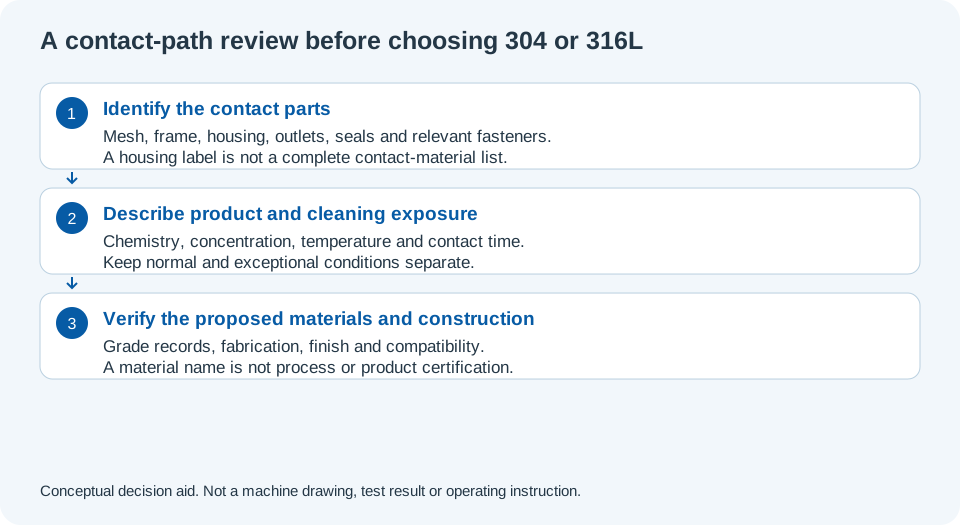
List each surface that contacts the material: mesh, frame, housing, outlets, fasteners and seals where relevant. Then identify what contacts those surfaces during cleaning, storage and abnormal but foreseeable operation. A housing material label does not identify every part in that path.
The diagram is a way to collect exposure information. It is not a validated hygienic design or an approved cleaning circuit. Ask for a part-specific contact-material list for the actual proposed machine.
What the grade names tell you—and what they do not
304 is commonly described as an austenitic chromium-nickel stainless grade. The 316 family includes molybdenum, and the L designation identifies a low-carbon variant under the relevant grade specification. Exact composition, designation and product form must be checked against the applicable standard and supplied material record.
These descriptions explain why the grades deserve different engineering review; they do not establish resistance in your process. Do not turn “contains molybdenum” or “low carbon” into a blanket statement that all corrosion, welding or cleaning concerns have been solved.
| Question | Useful evidence | Insufficient substitute |
|---|---|---|
| Which metal is actually supplied? | Applicable grade specification and traceable material record | A generic “stainless steel” brochure label |
| Which parts have that grade? | Product-contact component list and drawing | Assuming the frame, mesh and fasteners are identical |
| What is the exposure? | Product and cleaning conditions with temperature and time | An industry name or a single chemical name |
| How is it fabricated and finished? | Relevant welding, finish and inspection requirements | A grade name treated as proof of workmanship |
Describe the exposure as a range
Record normal and exceptional product conditions separately. Include cleaning agent identity, concentration, temperature, duration, rinsing and drying where applicable. If chloride contamination or another corrosive exposure is a concern, identify its source and plausible range rather than assuming the nominal product composition tells the whole story.
This information should go to a qualified materials/application review. Do not infer a safe service temperature, cleaning recipe or concentration limit from this article.
Include mesh, joints and non-metallic components
Mesh may have a different material specification or supplier from the housing. Welded areas, crevices, product retention and surface condition can also affect the service question. Seals, adhesives and cleaning-system components require their own compatibility assessment.
A change from a nominal 304 housing to a nominal 316L housing does not demonstrate that every contact component changed, that surfaces can be adequately cleaned or that a completed assembly meets a regulated requirement. Inspect the proposed bill of materials and agreed documentation.
Decide what documentation belongs in the quotation
Specify the documents that are actually required, who will review them and what components they must cover. Keep material identification, fabrication quality, cleanability assessment and application acceptance as distinct subjects.
For a regulated process, the responsible team must define the applicable requirements and evidence. Neither this guide nor an equipment photograph supplies certification or validates a manufacturing process. Where evidence is incomplete, make the proposal conditional rather than adding an unqualified compliance phrase.
A practical material-review checklist
Use this checklist to make the discussion specific enough to answer. If the grade cannot yet be selected, identifying the missing exposure information is a useful result.
- List the product-contact parts and their proposed materials.
- Record product conditions, contaminants and cleaning exposures.
- Identify temperature, time, rinsing, drying and abnormal conditions.
- State the applicable material designation and documentation needs.
- Review mesh, welds, finish, seals and assembly details separately.
- Record the limits of any compatibility recommendation.
Evidence boundary
The archived Zhenwei catalogue is a starting point for identifying equipment and available material discussions; it is not a part-by-part material certificate for a future order. No supplier certificate, corrosion-rate dataset, product approval or cleaning validation is reproduced here.
Confirm the proposed grade and contact parts on the actual quotation and drawings. The next step is a material/exposure review tied to that configuration, not a generic ranking of stainless steels.
Outokumpu’s Core and Supra product-range pages were read for the generic grade descriptions: Core 304 is described as a chromium-nickel austenitic grade, while Supra 316L is described as molybdenum-alloyed and low carbon. These supplier descriptions support the terminology only. They are not the material certificate, composition analysis or corrosion assessment of a Zhenwei machine.