
When is ultrasonic assistance worth evaluating?
Evaluate ultrasonic assistance when the required separation is limited by particles lodging in or adhering to the mesh, and when the proposed screen and ultrasonic system are compatible. First establish that the restriction really is at the screening surface. Unstable feeding, an excessive bed, unsuitable aperture or a leaking seal will not become a properly specified process merely by adding another energy source.
This is a mechanism-and-test guide. It does not report a Zhenwei on/off experiment, promise a throughput increase or say that every fine powder requires ultrasound.
Separate bulk movement from mesh assistance
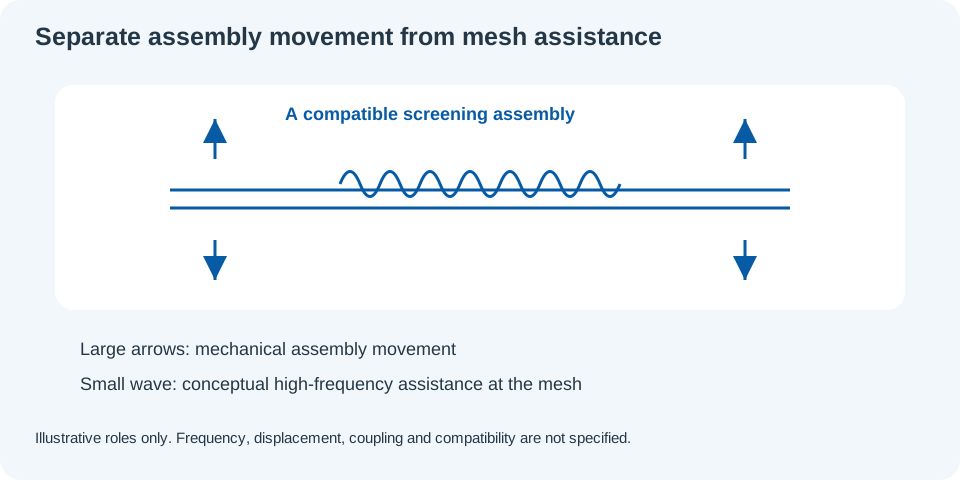
Mechanical vibration moves the screening assembly and presents material to the surface. Ultrasonic assistance adds high-frequency excitation through a compatible system to influence behaviour at the mesh. The two roles should be described separately: transporting a bed and keeping an opening available are not the same task.
Compatibility includes the mesh assembly, transmission components, mounting and permitted settings for the offered model. A laboratory ultrasonic sieve accessory and an industrial ultrasonic screening machine are not automatically interchangeable.
Identify what is restricting the separation
Inspect observations under the site’s authorised safe condition; do not reach into operating equipment. A photograph should identify the sample, time in the run and screen location. Different deposits can look similar after a machine has been stopped, so connect inspection with feed and outlet records.
| Observation | Question to investigate | Useful record |
|---|---|---|
| Particles lodged around the aperture size | Is near-aperture material pegging openings? | Aperture, feed-size distribution and location-specific images |
| A surface coating or agglomerated layer | Are moisture, cohesion or static effects relevant? | Sample condition, environment and run history |
| A deep or uneven bed | Is feeding or distribution exceeding the useful loading? | Actual feed rate and accumulation over time |
| Unexpected coarse particles in product | Is there mesh, seal or assembly damage? | Inspection and stream analysis; not a presumed blinding cure |
Screen the application for compatibility and risk
Ask for the approved assembly and operating limits for the actual screen. Confirm mesh condition and tension, electrical supply, cleaning chemicals, product temperature and how the ultrasonic components are inspected. These are specification questions, not instructions to retrofit an arbitrary transducer.
Combustible, reactive, toxic or temperature-sensitive powders need a separate safety and materials review. The existence of an ultrasonic option does not establish a hazardous-area approval, safe handling procedure or universal anti-static capability.
Write the on/off question before the trial
A useful comparison asks whether assistance changes an agreed outcome while preserving product quality. Where the system permits an on/off comparison, use the same compatible machine, mesh, material batch and target fraction. Record actual feeding, elapsed time, operating settings, ambient conditions and all collected streams.
Trial order can matter because the screen and material condition change over a run. An engineer should define repetitions and any interleaving or randomisation that is feasible and safe. One favourable short run is not a reliable production improvement percentage.
Measure more than feed rate
Define accepted-product output, accepted-stream size composition, oversize composition and the duration and reason for interruptions. Include a mass balance so retained product and uncollected material remain visible. Keep photographs and measurements tied to individual runs.
If assistance increases accepted output but also changes the product-size distribution, the decision depends on the quality specification. Report both effects. Do not label a larger passing mass as improved efficiency without identifying whether it is the correct material.
Keep, adjust or decline the option on recorded evidence
Keep the option only if the complete proposed arrangement meets the required separation and practical operating conditions. An inconclusive trial should lead to a clearer measurement or a different configuration question, not an invented improvement claim.
If the dominant problem was feeding, a damaged screen or a non-representative sample, resolve that cause before attributing changes to ultrasound. This is also why generic “ultrasonic versus standard” rankings are poor substitutes for a material-specific comparison.
Sources and the limits of this comparison
The industrial equipment context comes from archived Zhenwei ultrasonic-screen descriptions. The external equipment reference is used to distinguish ultrasonic assistance from ordinary bulk motion and to highlight compatibility; its results are not Zhenwei results. No unreviewed paper percentage is repeated here.
Hielscher: ultrasonic sieve assistance and equipment context ↗