
MATERIAL RECOVERY
Material recovery screening
Review the actual feed and target recovery rather than selecting a screen from a broad recycling label.
What needs to be separated?
Review the actual feed and target recovery rather than selecting a screen from a broad recycling label.
- Feed characterization
- Separation-target definition
- Machine-configuration review
Conditions that affect the selection
Describe the material composition, contamination, particle range and handling risks. Confirm the proposed equipment and project evidence for this specific recovery task.
Identify the actual recoverable fraction
Regrind, recovered granules and recycled powders should be assessed by composition and size-based objective. Screening does not automatically distinguish materials with the same particle dimensions, remove every contaminant or replace a complete recycling line. Mixed or hazardous feed needs a defined acceptance and handling assessment before a sample is sent.
Choose by the process checkpoint
| Process task | Candidate route | Selection and evidence boundary |
|---|---|---|
| Plastic pellets, regrind and recovered granules | Compare linear SZF and YB | Particle shape, bulk density and size-based rejection |
| Consistent reclaimed powder | Define particle fractions before selecting a fine-screening route | Composition, contamination and allowed retained product |
| Mixed or hazardous waste | Separate this from a standard size-grading enquiry | Not a complete recovery plant, optical sorter or universal waste-processing claim |
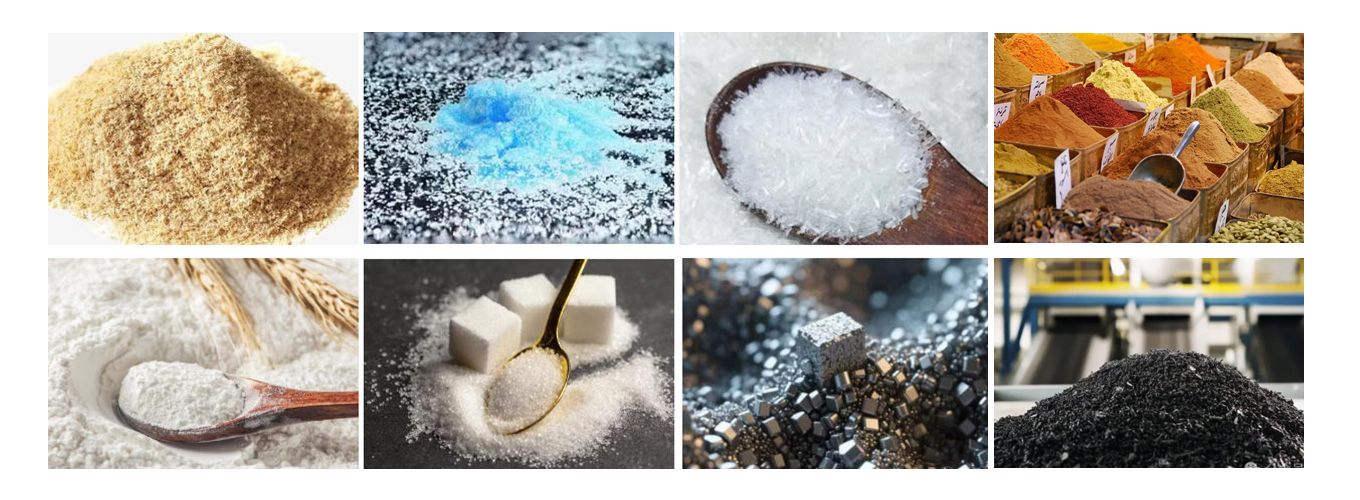
MATERIALS IN THIS INDUSTRY