
FOOD PROCESSING
Screening for food production
Define the ingredient, separation task and contact/cleaning requirements before choosing the equipment.
What needs to be separated?
Define the ingredient, separation task and contact/cleaning requirements before choosing the equipment.
- Ingredient safety screening
- Powder and granule classification
- Suitable liquid screening
Conditions that affect the selection
Consider foreign-material size, target product fraction, contact materials, cleaning, product changeover and the actual handling conditions.
Plan the inspection point
Locate the proposed screen in the ingredient or packing process and identify what is being rejected. Flour, spices and dairy powders can require different changeover and contact-material reviews. Screen integrity, retained material and cleaning access are relevant discussion points, while microbiological compliance and product certification require their own evidence.
Choose by the process checkpoint
| Process task | Candidate route | Selection and evidence boundary |
|---|---|---|
| Powder ingredient check screening | Compare WSQ and S49 | Feed point, oversize definition, seals and inspection |
| Crystal/granule grading | Review YB or linear/rectangular arrangements | Product fractions and permissible particle damage |
| Suitable liquids | Review filter / high-frequency routes | Viscosity, retained solids and cleaning at actual conditions |
Coffee, tea and shellfish are different screening questions
For coffee, distinguish whole beans, ground coffee and fines. For tea, distinguish leaves, fibres and powder. Size screening may use a circular, tumbling or linear route depending on shape and the accepted fraction; the same aperture does not imply the same result for each feed.
- Shellfish sizing is not the same task as filtering a food liquid. The current catalogue does not establish a validated shellfish-grading configuration; discuss the actual product and handling requirement before considering supply.
- A food-plant contaminant-removal request must identify the contaminant and separation principle. A screen does not replace metal detection, microbiological control or all inspection stages.
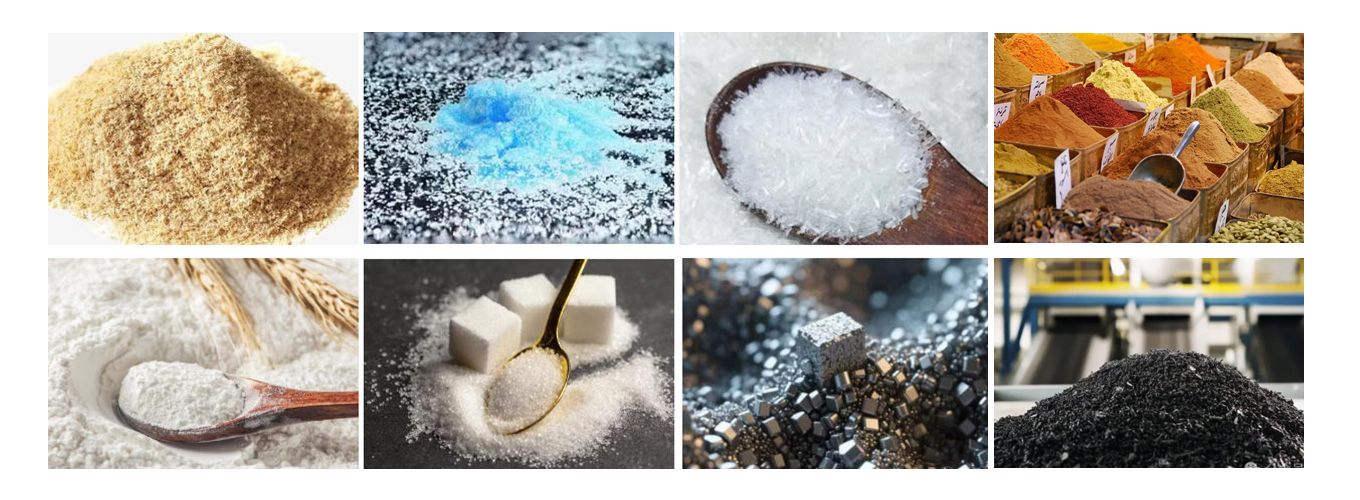
MATERIALS IN THIS INDUSTRY
Choose your material and separation duty
Starch Screening
Plan starch screening around moisture, powder flow, agglomerates and the desired separation between product and oversize.
Review This Material →Spices Screening
Plan spices screening around particle shape, oil content, aroma/product changeover and the desired cut size.
Review This Material →Milk powder Screening
Plan milk powder screening around powder flow, agglomeration, contact materials and cleaning/changeover requirements.
Review This Material →Rice Screening
Plan rice screening around grain condition, broken fractions, foreign-material targets and the handling process.
Review This Material →Cocoa powder Screening
Plan cocoa powder screening around fat content, cohesion, agglomeration and the target particle fraction.
Review This Material →Flour Screening
Plan flour screening around ingredient condition, foreign-material targets, aperture and product-changeover requirements.
Review This Material →Sugar Screening
Plan sugar screening around crystal/powder form, moisture, lump formation and target grades.
Review This Material →Salt Screening
Plan salt screening around crystal size, moisture, lump formation and contact-material compatibility.
Review This Material →